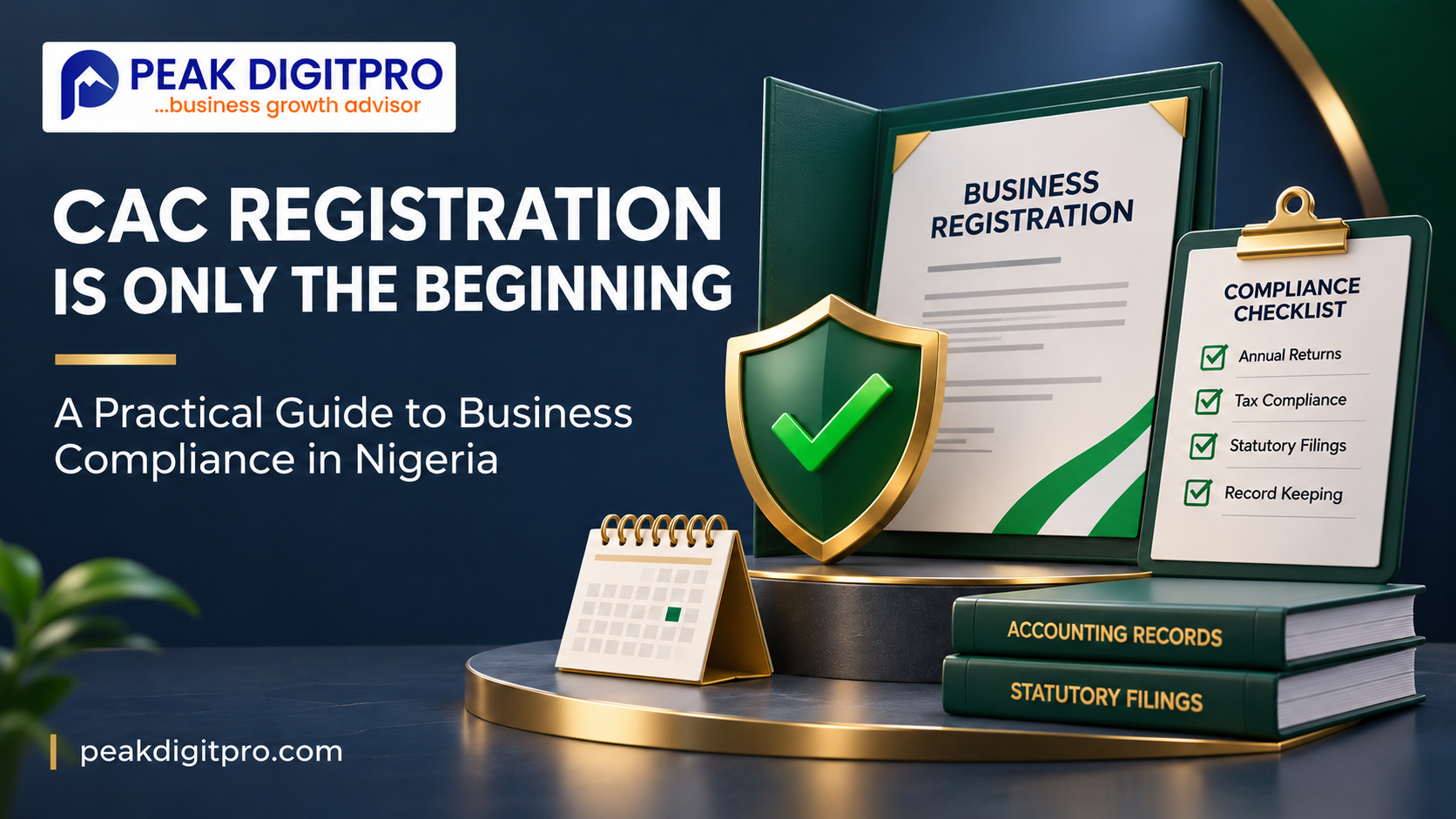
Registration with the Corporate Affairs Commission (CAC) is an important step in establishing a business in Nigeria. It provides a registered identity and forms the foundation for subsequent corporate administration.
Ongoing compliance requires continued attention after the registration process has been completed.
As your business operates, employs staff, earns income, and changes ownership or address, new obligations arise. Without a system for managing them, it is easy to miss a filing, lose supporting documents, or discover an unresolved issue when a client requests due diligence.
This guide explains what to review after CAC registration and how to build a manageable compliance routine.
What does business compliance mean in Nigeria?
Business compliance means meeting the legal and regulatory obligations that apply to your organization. Depending on your circumstances, these can include CAC filings, tax administration, employment obligations, operating licenses, and data protection.
Your requirements depend on your legal structure, location, activities, workforce and transactions. A sole proprietor, limited liability company, and incorporated trustee organization should not use the same checklist without adjustments.
An effective compliance framework identifies the obligations applicable to the organization, assigns responsibility for each task, and maintains evidence of completion.
1. Understand your registration structure
Start by confirming exactly what you registered.
A business name is different from a limited liability company. An NGO registered as an incorporated trustee also has a different governance and reporting framework.
Keep a clear record of your registration number, registration date, proprietors or directors, ownership information, registered address, and principal activities.
This prevents practical mistakes, such as using the wrong entity details on contracts or assuming that guidance written for companies applies to a sole proprietor.
2. File CAC annual returns when due
CAC annual returns are recurring statutory filings. They are separate from tax returns and should have their own place in your compliance calendar.
The filing timetable depends on the registered entity.
For registered business names, annual returns are due by 30 June each year, except in the calendar year in which the business name was registered.
Companies generally have annual-return obligations, subject to statutory exceptions. Section 421 of CAMA 2020 provides for submission within 42 days after the annual general meeting where that provision applies. The section excludes single-member companies, so confirm the applicable filing arrangements for the particular entity.
For incorporated trustees, the statutory annual-return window runs from 30 June to 31 December each year, excluding the year of incorporation.
Sources: CAMA 2020, sections 417, 421, 822 and 848.[1]
Confirm your first filing year, applicable documents and current CAC procedure before submission. AGM exemptions and other statutory exceptions require care.
Maintain a year-by-year return schedule and save submission acknowledgements, payment receipts and approval evidence together.
Request confirmation of completion and keep the relevant filing evidence alongside the service provider’s invoice.
3. Keep CAC records aligned with business changes
Review your records whenever your business changes its address, directors, ownership, name, or activities. Some changes require resolutions, supporting documents and separate CAC filings.
CAC lists post-registration services for changes involving directors, shareholders and persons with significant control, alongside annual returns.
Before implementing a significant change, identify the necessary approvals, statutory filings and corresponding record updates.
For example, if you move premises, check the effect on your CAC records, tax profile, bank records, invoices, licenses and contracts. Completing one update does not automatically complete the others.
4. Review beneficial ownership disclosures
For companies and limited liability partnerships, beneficial ownership compliance requires attention to the individuals who ultimately own or control the entity.
CAC guidance identifies persons with significant control by reference to ownership, voting rights, and other forms of significant influence. Its guidance includes a threshold of at least 5% for relevant shareholding or voting interests.
If ownership changes, or an investor participates through another entity, review who ultimately exercises control and what disclosures are required.
Do not assume that listing a corporate shareholder answers every beneficial ownership question.
5. Verify your tax identity and applicable obligations
Your CAC registration and tax administration records serve different purposes.
The official Tax ID guidance states that individual Tax IDs are linked to NINs, while non-individual Tax IDs are linked to CAC registration numbers. The Tax ID portal provides a retrieval process for registered entities.
Confirm that your business can retrieve its correct Tax ID and access the relevant filing platform.
Then establish which obligations apply. Your review should consider income tax, VAT, withholding tax, PAYE, and other applicable requirements. Treatment depends on the entity, transactions and current law.
A 2026 consideration: The Nigeria Tax Act 2025 took effect on 1 January 2026. Federal transition guidance distinguishes obligations relating to earlier periods from those administered under the new framework.[5]
Avoid relying on an old checklist without checking the relevant period and current rules. Where an exemption applies, establish separately whether registration, reporting or record-keeping duties remain.
6. Distinguish CAC returns from tax returns
One common source of confusion is the phrase “annual returns.”
A CAC annual return meets the applicable corporate registry reporting requirement. A tax return provides information required by the relevant tax authority.
Tax payment is a separate step that settles an assessed or otherwise payable liability. A tax clearance certificate provides evidence of tax compliance for the relevant period and purpose, subject to the issuing authority's requirements.
Track filing, payment, and clearance separately, with supporting evidence for each completed obligation.
Ask your adviser for separate status updates and evidence for each applicable obligation.
7. Keep reliable accounting records
Compliance becomes easier when records are organized throughout the year.
Maintain sales invoices, expense receipts, bank statements, payroll records, customer and supplier balances, asset records, loan documents and tax evidence.
Reconcile your bank accounts monthly and investigate unexplained differences promptly. Clearly identify money introduced by the owner, drawings, loans and transfers so they are not confused with ordinary sales or expenses.
A useful monthly reporting pack includes a profit and loss statement, a statement of financial position, a cash flow summary, customer receivables, supplier payables and a schedule of tax and statutory liabilities.
These reports also help you understand whether the business can meet its obligations without disrupting operations.
8. Review employment and payroll compliance
Hiring your first employee should trigger a compliance review.
Maintain written employment terms, payroll calculations, employee records, and evidence of applicable deductions and remittances.
Depending on the legislation's coverage and your workforce, review PAYE, pension, employee compensation, industrial training and group life insurance obligations.
Check applicability before assuming that a rule applies to every employer in the same way. Confirm current thresholds, deadlines and documentation with the relevant authority or a qualified adviser.
As a practical control, reconcile payroll to bank payments and statutory schedules each month.
9. Check sector, premises and data protection requirements
A CAC certificate does not by itself establish that every operating permission has been obtained.
Prepare a separate review of your actual activities, premises and customer information. Consider whether sector authorizations, product approvals, professional licenses or location-specific permits need specialist assessment.
Data protection also deserves attention when you collect customer, employee or supplier information. NDPC's implementation framework addresses duties under the Nigeria Data Protection Act and registration for designated controllers and processors of major importance.
Review what personal data you collect, why you need it, who can access it, and how it is protected. Assess NDPC registration requirements against the applicable classification rather than assuming every small business must register.
10. Build a compliance calendar with clear ownership
A calendar works best when every item has an owner and supporting evidence.
Review incoming official notices and collect missing transaction documents each week. At month-end, reconcile bank accounts, complete payroll checks, and assess obligations approaching their deadlines.
A quarterly review should consider outstanding compliance issues, ownership changes, permit requirements, and upcoming submissions. Annual planning should cover applicable CAC returns, tax returns, financial statements and license renewals.
Additional reviews are appropriate whenever the organization introduces new locations, employees, investors, directors, products or activities.
These management routines support timely administration; the actual statutory deadline for each obligation must be recorded separately.
For each obligation, record the authority, deadline, responsible person, reviewer, estimated cost, status, and evidence location. Set reminders sufficiently early to resolve queries before the due date.
What should you do if your compliance is already overdue?
Start with a documented status review.
Gather the registration documents, financial records and evidence of earlier filings. Use these records to identify outstanding years, incomplete updates, and unresolved official notices.
Confirm the applicable requirements and current charges before establishing an action plan. Prioritize statutory deadlines and matters affecting immediate transactions, complete the necessary filings or corrections, and retain supporting evidence.
Assign responsibility for a recurring review to prevent further outstanding obligations.
Be specific about the outcome you need. A client requesting proof of one filing may also need updated ownership records or separate tax evidence.
Frequently asked questions
Is CAC registration enough to operate a business in Nigeria?
It establishes registration under the applicable structure. You must separately assess tax, employment, sector, premises, and other obligations relevant to your activities.
Are CAC annual returns the same as tax returns?
No. They are separate filings serving different purposes and authorities. Completing one does not complete the other.
Do business names file CAC annual returns?
Yes. Section 822 of CAMA 2020 provides for annual returns by registered business names, with an exception for the calendar year of registration.[1]
Does having no sales remove every compliance obligation?
Do not assume it does. Review your entity's filing requirements, any available exceptions, and the appropriate treatment of inactivity with your adviser.
Should I wait until I need funding to organize my records?
Preparing earlier gives you time to resolve missing documents and discrepancies. Start with monthly bookkeeping and a clear filing history.
Make compliance part of your business growth plan
Good compliance management starts with clear responsibilities, reliable records, and timely action.
The objective is to know what applies to your business, complete it when due and produce evidence when requested.
Professional compliance support for your business
Peak DigitPro supports businesses with CAC and corporate compliance, accounting and financial reporting, tax compliance support, and Virtual CFO services.
Book a Business Compliance Review at https://peakdigitpro.com/services/CAC-and-Corporate-Compliance to identify outstanding obligations, organize your records, and develop a practical action plan.
Visit peakdigitpro.com to enquire.
This article provides general information as at 8 November 2026. Requirements depend on your entity and circumstances; confirm current rules before filing or making a compliance decision.